TLDR
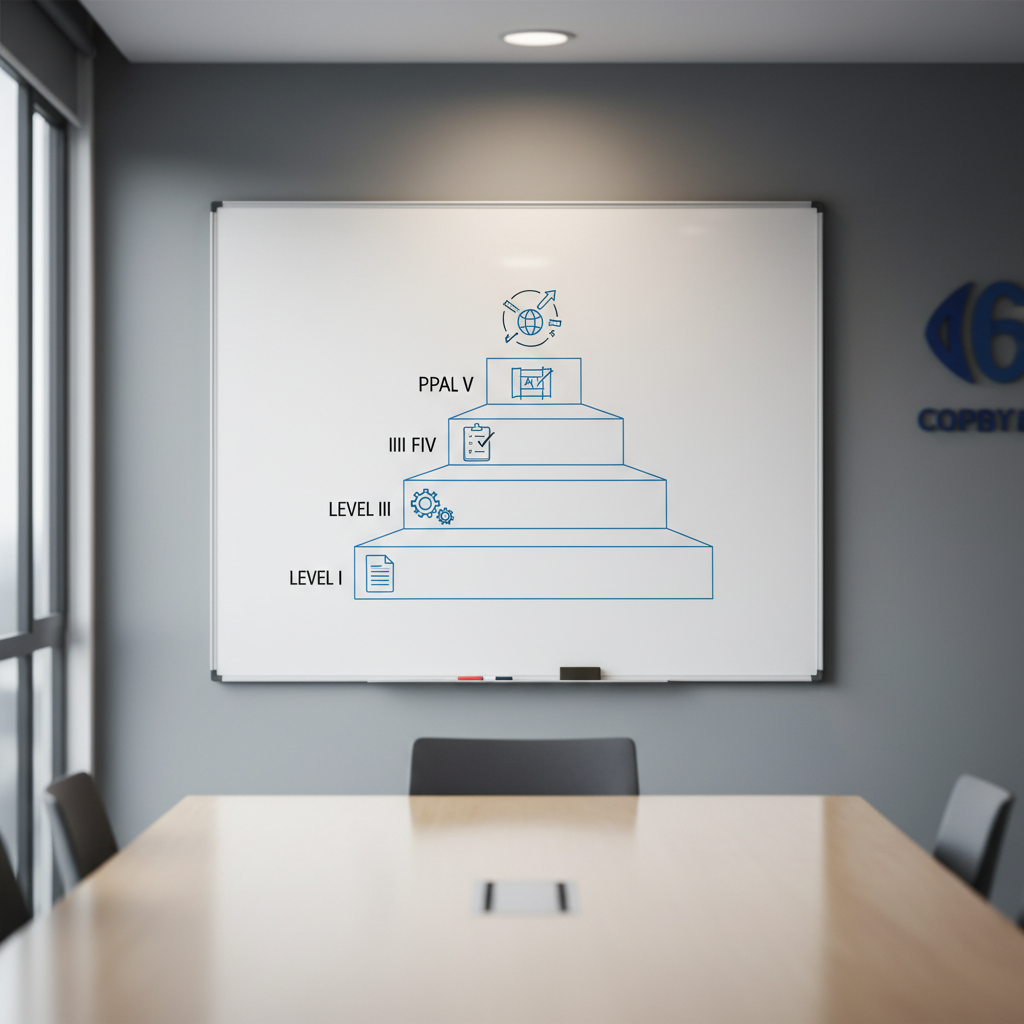
PPAP (Production Part Approval Process) has five submission levels that determine how much documentation you submit to the customer. Level 1 is the lightest (warrant only), Level 5 is the heaviest (full documentation plus on-site review), and Level 3 is the default for most automotive submissions.
This post explains what each level requires, when each is used, and what major OEMs typically demand.
What Are PPAP Submission Levels?
The Production Part Approval Process (PPAP) uses five submission levels to define how much documentation and evidence a supplier must provide to the customer. The levels range from Level 1 (minimum documentation) to Level 5 (maximum documentation with on-site review).
All five levels require the supplier to complete the same 18 PPAP elements. The difference is in what gets submitted to the customer versus what is retained at the supplier’s facility for review on request.
The customer determines the submission level. If no level is specified, Level 3 is the default per the AIAG (Automotive Industry Action Group) PPAP manual.
The 18 PPAP Elements: A Quick Reference
Before diving into the levels, here are the 18 elements that every PPAP submission must address:
- Design Records
- Authorized Engineering Change Documents
- Customer Engineering Approval (if required)
- Design FMEA (Failure Mode and Effects Analysis)
- Process Flow Diagram
- Process FMEA
- Control Plan
- Measurement Systems Analysis (MSA) Studies
- Dimensional Results
- Material and Performance Test Results
- Initial Process Studies (Cpk/Ppk)
- Qualified Laboratory Documentation
- Appearance Approval Report (AAR), if applicable
- Sample Production Parts
- Master Sample
- Checking Aids
- Customer-Specific Requirements
- Part Submission Warrant (PSW)
Regardless of the submission level, you are expected to have all 18 elements completed and available. The level simply determines which elements you send to the customer proactively.
Level 1: Warrant Only
Level 1 is the lightest submission. You submit only the Part Submission Warrant (PSW) to the customer. For appearance items, you also include the Appearance Approval Report (AAR).
What You Submit
- Part Submission Warrant (PSW)
- Appearance Approval Report (if the part has appearance requirements)
What You Retain
All other 16 elements are completed and retained at your facility. The customer can request to review them at any time.
When Level 1 Is Used
Level 1 is typically used for low-risk parts, standard catalog items, or situations where the customer has a high degree of confidence in the supplier’s quality system. It is also common for internal transfers where the supplier and customer are part of the same organization.
Level 2: Warrant With Limited Documentation
Level 2 adds key documents to the warrant. You submit the PSW along with sample parts and a limited set of supporting data.
What You Submit
- Part Submission Warrant (PSW)
- Sample production parts
- Dimensional results
- Material and performance test results
- Appearance Approval Report (if applicable)
When Level 2 Is Used
Level 2 is used when the customer wants to verify critical data without reviewing the full documentation package. It is common for parts with established processes or for suppliers with a strong track record.
Level 3: Warrant With Full Documentation (Default)
Level 3 is the default submission level when the customer does not specify otherwise. It requires the PSW plus full supporting documentation and sample parts.
What You Submit
- Part Submission Warrant (PSW)
- Sample production parts
- All supporting data and documentation, including:
- Design records
- Engineering change documents
- DFMEA (if design responsible)
- Process flow diagram
- PFMEA
- Control plan
- MSA studies
- Dimensional results
- Material and performance test results
- Initial process studies
- Qualified laboratory documentation
- Appearance Approval Report (if applicable)
- Checking aids documentation
- Customer-specific requirements
When Level 3 Is Used
Level 3 is the standard for most automotive PPAP submissions. If you are unsure which level your customer requires, prepare for Level 3. Most major OEMs default to this level unless they specify otherwise in their customer-specific requirements.
Level 4: Customer-Defined Requirements
Level 4 is a customized submission. The customer specifies exactly which elements they want to see, which may be more or fewer than Level 3. The requirements are defined by the customer on a case-by-case basis.
What You Submit
- Part Submission Warrant (PSW)
- Whatever additional elements the customer specifically requests
When Level 4 Is Used
Level 4 is used when the customer has specific concerns about certain aspects of the product or process. For example, a customer may request Level 4 with a focus on PFMEA and capability studies for a part with a history of quality issues.
Level 5: Full Documentation With On-Site Review
Level 5 is the most comprehensive submission level. It includes everything in Level 3 plus an on-site review at the supplier’s manufacturing facility. The customer’s quality representative physically reviews the documentation, inspects the process, and verifies the evidence in person.
What You Submit
- Part Submission Warrant (PSW)
- Sample production parts
- All supporting documentation (same as Level 3)
- On-site review and verification by the customer
When Level 5 Is Used
Level 5 is used for high-risk parts, safety-critical components, or new suppliers that have not yet established a track record. It is also common during new technology introductions or when previous launches from the supplier had significant quality issues.
Quick Comparison Table
Here is a summary of what is submitted at each level:
| Level | PSW | Samples | Dimensional / Test Data | Full Documentation | On-Site Review |
|---|---|---|---|---|---|
| 1 | Yes | No | No | No | No |
| 2 | Yes | Yes | Yes | No | No |
| 3 | Yes | Yes | Yes | Yes | No |
| 4 | Yes | Per customer | Per customer | Per customer | No |
| 5 | Yes | Yes | Yes | Yes | Yes |
Common OEM Requirements by Manufacturer
Each OEM has customer-specific requirements (CSRs) that may modify the standard PPAP levels. Here is what you can generally expect:
General Motors (GM): Typically requires Level 3 for production parts. GM uses its Supplier Quality Excellence system and may escalate to Level 5 for new suppliers or problem suppliers. GM also has specific requirements around Run at Rate and capacity verification.
Ford Motor Company: Defaults to Level 3. Ford’s customer-specific requirements include additional expectations around PFMEA methodology and special characteristics designation. Ford Supplier Quality uses the PPAP submission through its Supplier Portal.
Stellantis (formerly FCA): Generally requires Level 3. Stellantis has specific requirements around forever requirements, safe launch procedures, and run-at-rate demonstrations that supplement the standard PPAP elements.
Toyota: Does not use the AIAG PPAP system directly. Toyota uses its own supplier quality assurance process, though many of the same concepts apply. If you supply Toyota, follow their specific submission requirements.
Tier 1 Suppliers: Many Tier 1 suppliers flow down Level 3 requirements to their sub-suppliers. Some large Tier 1s have their own customer-specific requirements that add to or modify the standard PPAP elements.
How to Determine the Right Level
The customer determines the submission level. Check the following sources to confirm what is required:
- Purchase order or sourcing documentation: The PPAP level is often specified in the initial sourcing package.
- Customer-specific requirements (CSRs): Published by each OEM and available through IATF or the OEM’s supplier portal.
- Supplier quality manual: Many customers publish a supplier quality manual that defines PPAP expectations.
- Direct communication: When in doubt, ask your customer’s Supplier Quality Engineer (SQE). Submitting at the wrong level wastes time for everyone.
If no level is specified anywhere, default to Level 3. You will rarely be criticized for providing too much documentation.
Frequently Asked Questions
What is the default PPAP level?
Level 3 is the default per the AIAG PPAP manual. If your customer does not specify a level, prepare and submit a Level 3 package.
Do I still need to complete all 18 elements for Level 1?
Yes. All 18 elements must be completed regardless of the submission level. The difference is whether you submit them to the customer or retain them at your facility. The customer can request to see retained elements at any time.
Can a customer change the PPAP level after the initial requirement?
Yes. Customers can escalate or reduce the PPAP level based on supplier performance, part criticality, or other factors. A supplier with quality issues may be moved from Level 3 to Level 5.
What is the most common PPAP level?
Level 3 is by far the most common in the automotive industry. It provides full documentation without requiring an on-site visit.
Does Level 5 mean there is a problem?
Not necessarily. Level 5 is appropriate for safety-critical components, new technology, or new suppliers. However, it can also be triggered by past quality issues or customer concerns about the supplier’s capability.
Are PPAP levels used outside the automotive industry?
The PPAP level system is specific to the AIAG PPAP manual used primarily in automotive. However, aerospace (AS9145), medical device, and other industries have similar tiered submission concepts within their own quality frameworks.
What happens if my PPAP submission is rejected?
The customer will issue an interim or rejected status on the PSW and provide feedback on what needs to be corrected. You must address the issues, update the relevant documents, and resubmit. Production shipments are not authorized until the PPAP is approved.
Stay Current on Automotive Quality
PPAP updates, GD&T guidance, and practical quality resources delivered to your inbox. No spam, just what quality professionals need to know.
Subscribe


Leave a Comment