TLDR
Kaizen is a Japanese methodology built on the principle that small, continuous improvements compound into significant results over time. It is grounded in the PDCA (Plan-Do-Check-Act) cycle and uses tools like 5S, standard work, and visual management to drive daily improvement on the shop floor.
This post explains the core principles of kaizen, the PDCA cycle, the most common kaizen tools, and how to apply the methodology in a manufacturing environment.
What Is Kaizen?
Kaizen is a Japanese word meaning “change for the better.” In manufacturing and quality management, it refers to a philosophy and methodology of continuous, incremental improvement involving everyone in the organization, from executives to shop floor operators.
The methodology was popularized by Toyota as part of the Toyota Production System (TPS) and became a cornerstone of lean manufacturing worldwide. Unlike initiatives that seek dramatic transformation, kaizen focuses on small, daily improvements that are sustainable and cumulative.
Kaizen is not a tool or a technique. It is a way of thinking about work. Every process can be improved. Every person who touches a process has ideas for improving it. The organization’s job is to create a system that captures and implements those ideas.
The Core Principles of Kaizen
1. Continuous Improvement
There is no finish line. Every process, no matter how well it performs today, can be improved. The goal is not perfection but persistent, incremental progress.
2. Respect for People
The people closest to the work understand it best. Kaizen respects the knowledge and experience of operators, technicians, and frontline workers. Their ideas are the primary source of improvement, not top-down mandates from management.
3. Gemba (Go to the Actual Place)
Gemba is the Japanese word for “the real place,” meaning the shop floor or wherever work is done. Kaizen requires going to the gemba to observe, understand, and improve processes. Decisions made in conference rooms without visiting the shop floor are disconnected from reality.
4. Eliminate Waste (Muda)
Kaizen targets waste in all its forms. The Toyota Production System identifies seven types of waste: overproduction, waiting, transportation, overprocessing, inventory, motion, and defects. Some practitioners add an eighth: unused human potential.
5. Standardize, Then Improve
You cannot improve a process that is not standardized. If every operator performs a task differently, there is no baseline to improve from. Kaizen requires establishing standard work first, then improving from that standard.
The PDCA Cycle: The Engine of Kaizen
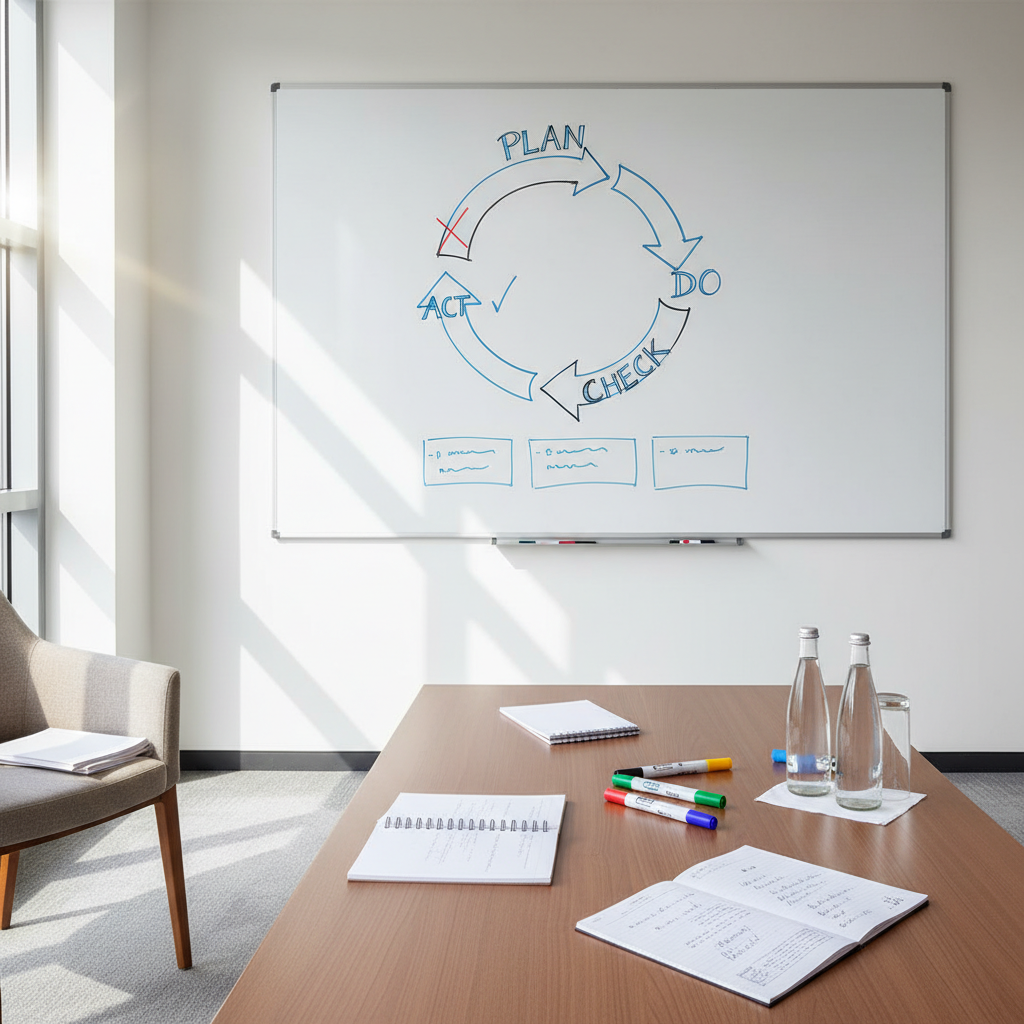
The PDCA cycle (Plan-Do-Check-Act), also known as the Deming cycle or Shewhart cycle, is the fundamental improvement framework used in kaizen. Every improvement follows this four-step cycle:
Plan: Identify the problem, analyze the current state, determine root causes, and develop a plan for improvement. Define what you expect to happen.
Do: Implement the improvement on a small scale. This is a trial, not a full rollout. Test the change and collect data.
Check: Compare the results to what you expected. Did the change produce the intended improvement? What unexpected effects occurred?
Act: If the change worked, standardize it. Update work instructions, train all operators, and make the improvement permanent. If it did not work, learn from the experiment and start a new PDCA cycle.
The key to PDCA is that it is a cycle, not a one-time event. After completing one cycle, you start the next. Each cycle builds on the last, creating a spiral of continuous improvement.
Essential Kaizen Tools
5S
5S is a workplace organization methodology with five steps: Sort (remove unnecessary items), Set in Order (organize what remains), Shine (clean the work area), Standardize (create visual standards), and Sustain (maintain the discipline). 5S is often the first kaizen activity because it creates a clean, organized foundation for further improvement.
Standard Work
Standard work documents the current best-known method for performing a task. It defines the sequence of steps, the cycle time, and the work-in-process inventory. Standard work is the baseline that makes improvement measurable. Without it, every operator does things slightly differently, and improvement cannot be sustained.
Visual Management
Visual management makes the status of work, processes, and performance visible at a glance. Examples include production tracking boards, andon lights that signal problems, floor markings for material placement, and color-coded tools. When performance is visible, deviations are immediately apparent.
5 Whys
The 5 Whys is a root cause analysis technique. When a problem occurs, you ask “why” repeatedly (typically five times) until you reach the fundamental cause. It is simple but effective for everyday problem-solving on the shop floor.
Value Stream Mapping
Value stream mapping (VSM) is a visual tool for analyzing the flow of materials and information through a process. It identifies value-added and non-value-added steps, highlights bottlenecks and waste, and guides the design of a future state. VSM is typically used at the beginning of larger kaizen initiatives to set direction.
Suggestion Systems
A kaizen suggestion system captures improvement ideas from all employees. Unlike traditional suggestion boxes where ideas disappear, an effective kaizen suggestion system has a rapid review process, quick implementation of approved ideas, and feedback to the submitter. The goal is volume: hundreds of small improvements per year rather than a few large ones.
Daily Kaizen vs. Kaizen Events
Kaizen operates at two levels:
Daily kaizen (also called “point kaizen”) is the ongoing, day-to-day practice of making small improvements. An operator notices that reaching for a tool adds 3 seconds to every cycle, moves the tool closer, and updates the standard work. These tiny improvements happen continuously and accumulate over time.
Kaizen events (also called kaizen blitz or rapid improvement events) are structured, multi-day workshops focused on a specific process. A cross-functional team dedicates 3 to 5 days to analyzing a process, implementing changes, and verifying results. Kaizen events tackle larger problems that require concentrated effort.
Both are essential. Daily kaizen maintains momentum between events. Events deliver step-change improvements that daily kaizen alone cannot achieve. Organizations that only do events miss the power of daily improvement. Organizations that only do daily kaizen miss the power of focused, cross-functional problem-solving.
Implementing Kaizen in Manufacturing
- Start with leadership commitment. Kaizen requires management to value small improvements, allocate time for improvement activities, and respond quickly to employee ideas.
- Train the team. Provide basic lean and kaizen training to all employees. Focus on waste identification, 5S, standard work, and the PDCA cycle.
- Begin with 5S. Workplace organization creates visibility and establishes the discipline needed for further improvement.
- Establish standard work. Document current processes to create a baseline. You cannot improve what you have not standardized.
- Launch a suggestion system. Make it easy for employees to submit ideas. Respond within days, not months. Implement quickly.
- Run kaizen events. Schedule focused improvement events on high-impact processes. Start with 2 to 4 per year and build from there.
- Measure and celebrate. Track improvement metrics. Recognize contributions publicly. Share results across the organization.
Frequently Asked Questions
Is kaizen the same as lean manufacturing?
Kaizen is a core component of lean manufacturing, but they are not the same. Lean manufacturing is the broader system that includes kaizen along with other elements like just-in-time production, jidoka (built-in quality), and heijunka (production leveling). Kaizen is the continuous improvement engine within the lean system.
How does PDCA differ from DMAIC?
PDCA (Plan-Do-Check-Act) is a general improvement cycle used in kaizen and lean. DMAIC (Define-Measure-Analyze-Improve-Control) is a more structured, data-intensive methodology used in Six Sigma. PDCA is simpler and faster, making it better suited for daily kaizen. DMAIC is more rigorous and appropriate for complex, data-driven problems.
Can kaizen work without management support?
Individual improvements can happen without management support, but a sustainable kaizen culture cannot. Management must allocate time for improvement, respond to suggestions, and remove barriers. Without this, kaizen remains a grassroots effort that eventually fades.
How do you measure kaizen success?
Common metrics include the number of improvements implemented per month, cost savings, scrap reduction, cycle time reduction, changeover time reduction, and employee participation rate. Track both the quantity of improvements and their cumulative impact.
What is the role of the supervisor in kaizen?
Supervisors are the critical link between management and the shop floor in a kaizen culture. They coach operators in problem-solving, review and approve suggestions, ensure standard work is followed, and escalate issues that require resources beyond their authority.
Is kaizen relevant to quality management systems like ISO 9001?
Yes. ISO 9001 requires continual improvement as a fundamental principle. Kaizen provides a practical methodology for fulfilling this requirement. Documented kaizen activities, suggestion records, and improvement metrics serve as evidence during quality system audits.
Stay Current on Automotive Quality
PPAP updates, GD&T guidance, and practical quality resources delivered to your inbox. No spam, just what quality professionals need to know.
Subscribe


Leave a Comment